
Season 2 | Episode 3
The Carer Paradox
Show Notes
We call people in healthcare and parenting “strong.” Capable. Reliable.
Here’s the truth. Being capable doesn’t mean we’re coping. Support is not just hand holding. It is inclusion, clear systems, kind language, and real rest.
In this episode I talk about emotional labor, the cost of pushing through, and why curiosity builds better care. We ask for everyone’s needs, not just the person who is struggling. We share the load so community actually feels like community.
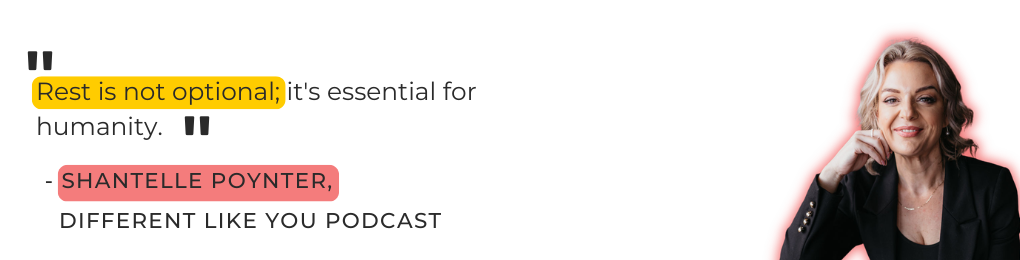
Rest is not optional. Your capacity does not mean you don’t care. You deserve space, boundaries, and consideration.
This podcast was built in the wild. School drop off. Midnight meltdowns. Platform Crocs. Real life, not a studio set. Because everyone is different, just like you.
Feel this? Share it. Say it. Start the convo.
---
Connect with Shantelle: https://linktr.ee/Shantellepoynter
Transcript
Shantelle | Nurse | Educator | Founder (00:01.026)
This podcast wasn't born in a studio. It was built in the wild moments of real life, the messy and the beautiful ones. I'm Shantelle, nurse, solo mum and your healthcare hype girl in platform Glittercrocs. Welcome to Different Like You, where we have real conversations about inclusion, kindness and what it means to be fully human.
What if the person holding it all together is actually crumbling quietly? What if the strongest person you know is the one who gets checked in on the least? Today's episode is for the givers, the default parent, the go-to coworker, and the one who always knows what to do. But here's the truth. The strong one gets tired too. Every time I walk into a shift as a nurse, there's an unspoken rule that we are the ones that
hold it down, hold it together. And when things fall apart emotionally, logistically, interpersonally, someone glances at me. And so they should, we're the nurse. We've got the backup plan. Sometimes we do, sometimes our team does, and most of the time we're pretty tired too. The same thing on placement as a student. I found myself being the one who's holding emotional space.
for the staff, reminding them that their worth isn't in their payroll number, but in who they are as clinicians and that the red tape will always be there, but the person at the other end receiving their care is who matters. And it's their registration on the line. Even at TAFE and res school, when people have been confused or overwhelmed by instructions, process, assignments, I'm the one explaining the content, even while I'm still processing it myself.
even when the lecturers are in the room. And then there's being a mum, especially a solo mum. We're the default for everything. This goes for any solo parent, even when another adult is standing right there. I can be outside, someone else can be in the kitchen and still the kids will come to me to ask for a drink. It's not personal, it's their programming. We are the first to ask because we've never dropped the ball. Even
Shantelle | Nurse | Educator | Founder (02:21.23)
when we're juggling fire. But being capable doesn't mean that we're coping. Just because we can carry it doesn't mean we should carry it all. Being neurodivergent and the strong one means people assume that you've got strategies or that you're already so overwhelmed so they don't ask. But support doesn't always look like hand holding. Sometimes it looks like
hey, what do you do to clear your mind? And when was the last time you got to do that? It looks like people buying into our self care as much as they buy into asking for our help. It's noticing that we're working an unfamiliar role and saying, hey, I saw you're working in a different area today. How are you finding that?
It's moments when we're hearing our bosses say, or our leaders say, that meeting looked exhausting. Feel free to decompress, take a walk, take some time for yourself. I know you'll make up the time later.
What would make today more workable for you?
We should be asking this for everyone, not just the ones that we think that are struggling or the ones with a diagnosis. This is the value in making considerations for all humans, not just adjustments for those with a diagnosis. We need to shift the narrative that support is for the weak, that rest is optional and that asking for help is a burden. It's not, it's what keeps us human, connected, considerate. If we want inclusion that works,
Shantelle | Nurse | Educator | Founder (03:59.2)
In families, in workplaces, in schools, we need to lead with curiosity before making a judgment. And I'm curious, like genuinely I'm curious to know what are you doing in your family or workplace to shift away from that default, you know, coworker who's always got it together or the default mum mode? Are you divvying up the emotional labor and how do you do that? Do you share calendars?
Are you just naming the mental load out loud? Do you have lists? Please DM me, send me an email. I want to know, I want to learn. Let's crowdsource some better ways to do this together. And if you are the strong one, I see you, I am you, I know you. Your capacity doesn't mean you don't care. You don't need to break to deserve rest. You're allowed to be tired.
You're allowed to stop when you're tired and you're allowed to not be the answer.
Thanks for hanging out with me today on Different Like You. These conversations really matter. I'm Shantelle, your healthcare hype girl, reminding you to be kind, be curious, and always be learning. If this resonated, share it with a friend. Let them know that they deserve space, rest, and consideration.
Share with a friend