Season 2 | Episode 4
It's Never "Just Socks"
Show Notes
Socks are not the problem
I need to talk about socks.
Not because I’m running out of things to say, but because socks are one of those “small” things that exposes a bigger truth in education. The system is obsessed with compliance. Same uniform. Same rules. Same expectations. And neurodivergent kids get the message loud and clear: fit in, even if it hurts.
As a nurse and educator, I see it all the time. A child is distressed, overwhelmed, sensory overloaded, and instead of curiosity, they get correction. Instead of care, they get consequences. Socks become the battle, but the real issue is that we keep prioritising what’s easy to manage over what’s actually kind.
In this episode, I use the sock saga as a metaphor for what happens when schools and systems ignore individual needs. Inclusion is not uniformity. It is understanding. It is asking, “What’s going on for you?” before deciding a child is being difficult. It is choosing care over control.
If you’re a parent, educator, or someone who grew up being told you were “too sensitive”, this one will land.
Listen on Spotify or Apple, link in bio.
Feel this? Share it. Say it. Start the convo.
Question for you: What is the “small” thing that people dismissed, but it was never small for you?
Transcript
Shantelle | Nurse | Educator | Founder (00:00.398)
Let them wear the damn socks. Let them wear the socks that work. You're listening to Different Like You. I'm Shantelle and today we're diving into a very personal rant and one that starts with a question. A really simple one. Why are socks still more important than the students? It's February here in Queensland. School's just gone back. The sun is still brutal and the routines are shaky for a lot of our neurodivergent families.
We're already tired. We have been preparing for this part of this year since last year. Let me take you into something that happened recently. I'm getting my kids ready for school. A lot of you will be familiar with this. They're overstimulated. They're tired. We're managing the juggle and we're really trying hard just to show up.
But we can't stop and focus on what we actually need in that moment and their wellbeing and how their effort or their actual needs. We're focusing on making sure that we've got the right socks to wear at school on the right day. Yep. We're still doing that. And before you come at me with the, you should get the socks out the night before we did. And when we got them out, we didn't have the information that we had in the morning. Okay.
So this is probably, I thought it was a minor thing, but it probably is something that would hit us hard three or four times a week. The anxiety surrounding the uniform that they have to wear is so significant that it becomes a barrier to going to school. Wild, right? I know that it seems small with the socks, but it's not. This is about the system. The way we continue to send
struggling kids into environment that value compliance over care. Let's be really clear. If a kid can get out of bed and get dressed and show up for school on a hard day, that's a hella win, right? But instead of honoring that, we're obsessing over the visible and completely ignoring the invisible effort that is so valuable. We're worried about the type of socks, haircuts, eye contact, sitting still.
Shantelle | Nurse | Educator | Founder (02:20.535)
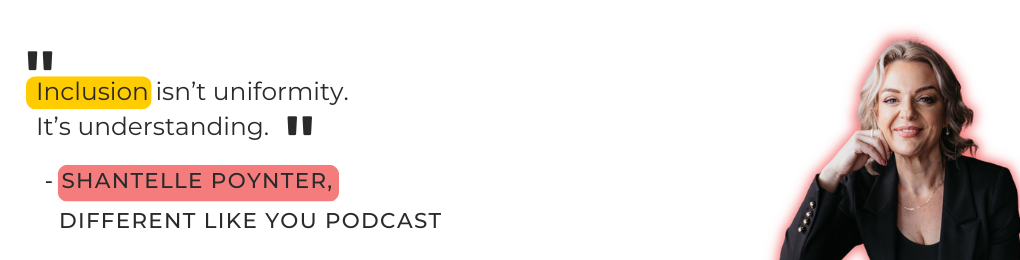
Inclusion isn't about uniformity. It's about understanding. When the systems we're in prioritise uniform rules over realities, we're teaching our kids that who they are matters less than how they look. And I think that's messed up. Now I understand in some occupations, a uniform is really important. And I also understand
the social aspect of the uniform of creating cohesion and, you know, looking after what you're wearing. But I really don't, I think all of that really needs to be secondary to the actual child. So here's what I wish. Policy makers understood from a parent's perspective, sometimes the only socks that are clean are the sports ones. Even though I've bought
six packets of each pair. Sometimes the sensory input of the socks and the fabric and the tightness of them in their particular shoes is not going to be okay. And sometimes wearing the wrong socks is the only way that my child's making it out the door. Inclusion should never feel like a performance. And yet for so many kids,
and parents, especially neurodivergent ones, that's exactly what our school systems have become, a daily performance where we're encouraged to put on a mask, push down how you're actually feeling and not prioritise understanding yourself and how to navigate the tricky situation. We just keep filling them up with explosive feelings and not giving them an opportunity to be supported. And then when they're explored,
we're surprised and we punish them. So next time you see a kid in sports socks and it's formal day or vice versa, I really encourage you to make the observation, lead with kindness first and then curiosity before you make an assumption and punish the child. Hey, what did you have for breakfast today? That can be your first question. If they say nothing,
Shantelle | Nurse | Educator | Founder (04:37.785)
That probably gives you a really good indicator of their mourning. And do you think, and do you really value, punishing them for their socks is more important than maybe helping them figure out if having something to eat now will be helpful for them? Because real inclusion isn't about forcing rules and creating the punishment. It's about noticing what's really going on underneath. Because if in the morning you see that that child's not
or that they're wearing different socks and you have that conversation about, know, lead with curiosity, what did you have for breakfast this morning? And they say nothing. Are they going to go into a classroom environment and it be suitable for them to learn? No, they're hungry. They're stressed. They know they're wearing the wrong socks and they're sitting on the edge wondering when they're going to get detention for wearing the wrong socks.
That's it for today's episode. this landed you're at tag a teacher, send it to your school principal. I'm open to having more conversations with more people about what they're experiencing. If you're an educator, if you're in a leadership position at a school, or if you're a parent, I'd love to hear from you. You've been listening to Different Like You. I'm Shantelle, your healthcare hype girl, reminding you to be kind, be curious, and always be open to learning.
When we keep sending our kids into education systems that care more about the socks they're wearing than who they are, we've missed the mark 100%.
Share with a friend