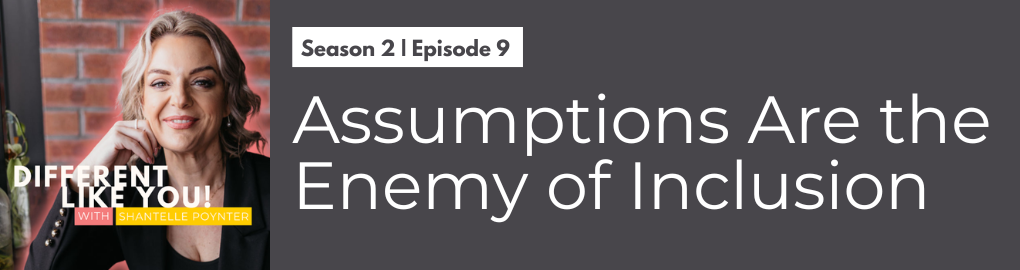
Season 2 | Episode 9
Assumptions Are the Enemy of Inclusion
Show Notes
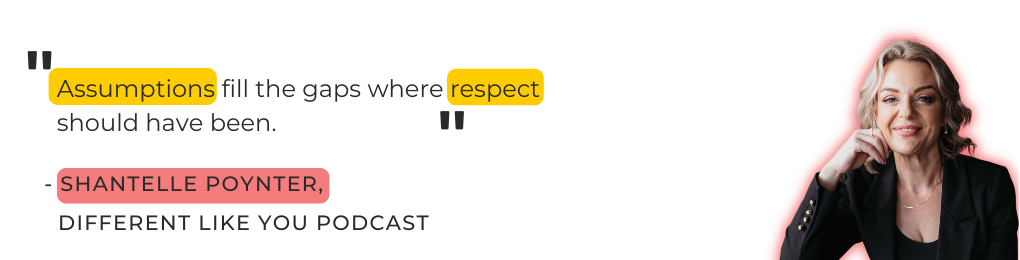
“Assumptions fill the gaps where respect should have been.”
– Shantelle Poynter
I want to talk about assumptions, because they do more damage than people realise.
In healthcare, in education, and in everyday relationships, assumptions can turn into shortcuts that strip people of safety, dignity, and voice. We decide what someone means, what they need, what they can handle, or who they are, without actually asking. And once that happens, real connection disappears.
This episode is about what assumptions do to people and why curiosity matters more. I talk about how active listening, respect, and the least dangerous assumption can change the way we show up for each other. Because when we assume less and listen better, we create more safety, more understanding, and better relationships. Not just for neurodivergent people, but for everyone.
Highlights:
- Assumptions distort reality and can do real harm
- Curiosity creates connection where judgment creates distance
- Active listening is part of respect, not an optional extra
- The least dangerous assumption is to assume people deserve dignity, voice, and support
- Safer systems start with asking, not deciding for people
If you work in healthcare, education, or any space where trust matters, this one will land. And if you’ve ever been on the receiving end of someone else’s assumption, you already know how heavy that can feel.
The answer is not perfection. It’s slowing down long enough to ask better questions, listen properly, and stop confusing confidence with understanding. Respect first. Curiosity next. That’s where safer relationships start.
Feel this? Share it. Say it. Start the convo.
🔗 LINKS
Website: https://shantellepoynter.com
Instagram: https://www.instagram.com/shantellepoynter/
Transcript
SHANTELLE (00:01):
This podcast wasn't born in a studio. It was built in the wild moments of real life, the messy and the beautiful ones. School drop-offs, cold coffee, and whispered pep talks to myself that maybe just maybe there's more to life than only surviving. I'm Chantel, nurse, neurodivergent woman, solo mum, and your platform Glitter Crocwearing Healthcare Hype Girl. I'm driven by one purpose. To show the world that different doesn't mean less because everyone is different, just like you. The more we talk about being considerate of all humans, not just in response to a diagnosis, the more it becomes part of everyday life. So welcome to Different Like You, where we have real considered conversations about inclusion, kindness, and what it means to be fully human. If someone here resonates, share it with a friend because these conversations change the world. One listener at a time. Let's get into it.
(01:02):
Assumptions are evil, and this is what happens when we think we know. You're listening to Different LikeYou. I'm Chantel, neurodivergent nurse, solo mum, queen of the side quest, and your healthcare hype girl in platform Glitter Crocs. Today, I want to talk about something that quietly and sometimes loudly causes so much harm every day and it's everywhere and it's assumptions. They are literally everywhere. They shape how we see each other, how we speak to each other and how we support or don't support one another. And honestly, my belief is that assumptions are really damaging. They don't just distort reality. They actually really hurt people. Let's talk about what happens when we assume. To the person making the assumption, it can feel like efficiency, logic, just trying to help, common sense. And we put that blanket over it and we dress it up as doing a good thing.
(01:58):
But to the person being assumed about, it feels like being misread, being minimized, or even being feeling completely invisible. And that disconnect is what really damages relationships and reduces trust and access. So if we use an example of a child in school, they're overwhelmed, they're melting down, they're hiding under a table. The assumption, they're misbehaving. They're making bad choices. The reality is that they're distressed, dysregulated, and they've hit the wall. Their volcanoes explode. They actually have no capacity for rational thought in that moment because they're dysregulated. But the result, punishment, isolation and labels, or you're an adult at work. And the assumption is they need quiet. They don't always make eye contact. They maybe forget deadlines. So this assumption is that they're rude, they're disorganized, they're difficult, they're unreliable. The reality is that they might be neurodivergent. They might be chronically ill. They might be grieving or just a human in a system that is poorly designed.
(03:04):
The harm isn't just theoretical. It's emotional and institutional. Worst of all, it puts the pressure on the person being judged to correct the record. So we just give them more things to do. So let's flip that. What if we don't assume we get an opportunity for connection, an opportunity for more information? Really importantly, we have an opportunity to gain consent and respect from this person and the chance to actually meet someone where they're at and not make them feel less for where we think they should be. The most respectful thing that you can do to somebody else is to lead with curiosity and then shut up and listen and actively listen. If you haven't heard about active listening, please do cheeky little YouTube, Simon Sinek, active listening, and he will help you. He's the GOAT. Go and have a listen. The least dangerous assumption, a concept from education disability justice teaches us that when we're unsure, we should assume the most respectful, empowering thing possible.
(04:13):
And this is where I always try and make it really simple because I am an exhausted, tired mom, so I be kind, be curious, and be open learning. And that helps override maybe my emotional response if my child is having a really tough time and I'm also dysregulated because assuming the worst does more than limit somebody's potential, it destroys their sense of safety. Safety is not your perception. It's how that person is feeling. It's invisible to you. So if you have a thought that you have created the safest option, it's not actually up to you. It's the person experiencing it. Assumptions don't protect people. They protect the systems that are poorly designed and they keep us from seeing the full messy, beautiful complexity of the wonderful humans in front of us and especially our children that are growing up thinking that they're not worthy, that they're not good enough, that they need to be better.
(05:16):
So if you catch yourself filling in the blanks about somebody else, their experience, their identity, their ability, their support needs, their parenting or anything else, I really encourage you to pause for a moment. Prioritize kindness, lead with curiosity, ask and observe because the only thing I think being worse and being misunderstood is being too exhausted to correct it. That's it for today. Share this with someone who you think needs to hear it. Maybe save it to listen to another day because maybe that person's you. You've been listening to Different LikeYou. I'm Chantel Pointer, and I encourage you to be kind, be curious, and always be learning because everybody's different, just like you. And please remember, the cost of being wrong isn't just yours. It lands on the person that you assumed about. The only thing worse than being misunderstood is being too exhausted to correct it.
(06:06):
Assumptions don't protect people. They protect poorly designed systems. What happens if we don't assume, but we lead with curiosity? We allow a possibility of connection, clarity, and most importantly, consent. Ask and then shut up and listen in true ADHD style. Thanks for hanging out with me on Different Like You Today. These conversations matter because when we take the time to have considered conversations, the world gets a little kinder and a lot more humans. I'm Chantel, your healthcare hype girl, reminding you to be kind, be curious, and always be learning. If this resonated with you, share it with a friend, because small actions create change to support everyone. After all, everyone's different, just like you. Until the next step, keep showing up exactly as you are.
Share with a friend